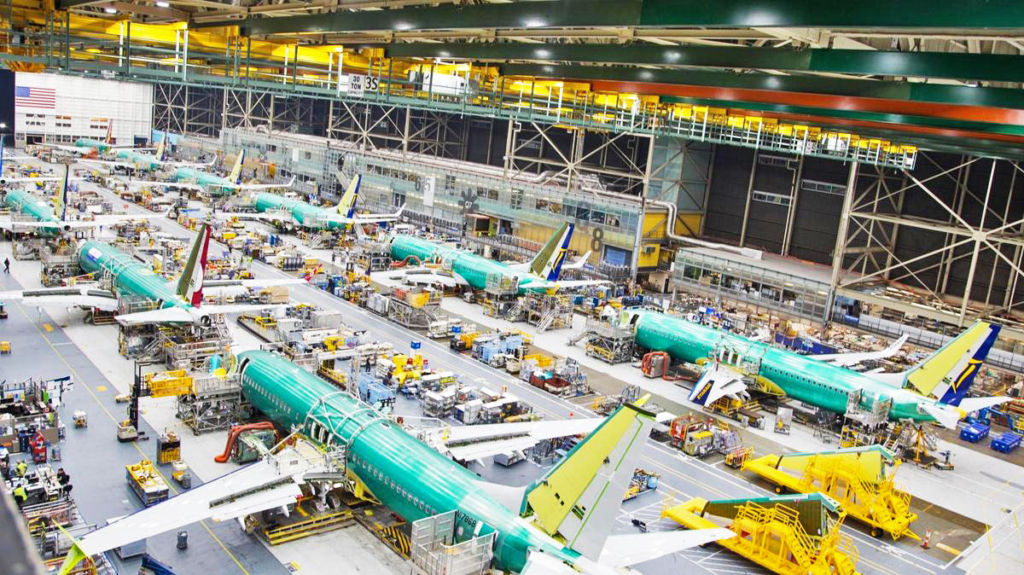

Okay, I’ve analyzed the provided text about the Boeing 737 MAX assembly process. Here’s a summary of the key information, organized by the requested categories:
**1. Stages of Assembly (Summarized):**
* **Stage 1: Fuselage Preparation:** Initial wiring and hydraulic systems installation.
* **Stage 2: Fuselage Joining:** Joining the front and rear fuselage sections.
* **Stage 3: Initial Systems Installation:** Installing electrical systems and other components.
* **Stage 4: Fitting Wings and Landing Gear:** Attaching wings, tail surfaces, and landing gear.
* **Stage 5: Galleys, Lavatories, and Fuel Systems:** Installing cabin modules and fuel tanks, pressure testing fuel tanks.
* **Stage 6: Power and Cabin Equipment:** Activating electrical power, installing air distribution, cabin sidewalls, and forward galleys/lavatories.
* **Stage 7: Pressure and Control Checks:** Testing for leaks, exercising landing gear, and testing flight controls.
* **Stage 8: Passenger Seats and Cabin Finishing:** Installing seats, carpet, and using a specialized conveyor system.
* **Stage 9: Installing Engines:** Mounting the CFM International LEAP-1B engines and connecting them to aircraft systems.
* **Stage 10: Final Checks and Outstanding Work:** Addressing remaining issues and conducting final inspections.
**2. Key Processes and Technologies:**
* **Overhead Crane:** Used to move the fuselage.
* **Parallel Assembly Lines:** West, Central, and East lines.
* **Conveyor System:** Used for installing passenger seats.
* **Pressure Testing:** Used to check fuel tanks and cabin for leaks.
* **Simulated Procedures:** Used to test flight controls.
* **Factory-Tour Account:** Used to describe the installation equipment for seats.
**3. Timeline and Production:**
* **Estimated Assembly Time:** Approximately 15 days from fuselage entry to near-completion.
* **Shifts:** Three shifts operate around the clock.
* **Production Rate:** Moving towards 47 aircraft per month, with plans to reach 52 by early 2027.
* **Expansion:** A fourth production line (North Line) is being activated at the Everett facility.
**4. Quality Control:**
* **Regular Inspections:** Throughout the entire assembly process.
* **Defect Identification:** Workers search for defects, unfinished items, and debris.
* **Pressure Testing:** Used to identify leaks.
* **Flight Testing:** Conducted after the aircraft leaves the assembly building.
**5. Supply Chain and Coordination:**
* **Component Delivery:** Timely delivery of components is crucial.
* **Coordination:** Requires coordination between workstations, engineering, and production teams.
* **Supplier Network:** Relies on a broad supplier network.
**6. Virgin Australia and the 737 MAX:**
* **Fleet Renewal:** The 737 MAX is part of Virgin Australia’s fleet renewal plan.
* **Fuel Efficiency:** Offers fuel-efficiency improvements compared to older models.
* **Fleet Commonality:** Allows for shared training, maintenance, and support.
**7. Challenges:**
* **Increasing Production:** Balancing increased production with quality and inspection processes.
* **Component Delivery:** Ensuring timely delivery of components.
* **Coordination:** Coordinating suppliers, production teams, and quality control.
* **Software Problem:** The 737 MAX 10 faces new FAA delay after a software problem.
**8. Overall Significance:**
* **Complex Manufacturing:** Illustrates the complexity of commercial aircraft manufacturing.
* **Specialized Production:** Combines specialized production, systems integration, and inspections.
* **Airline Benefits:** Supports fleet renewal, capacity planning, and operating efficiency.
* **Boeing’s Challenge:** Increasing production while maintaining quality.