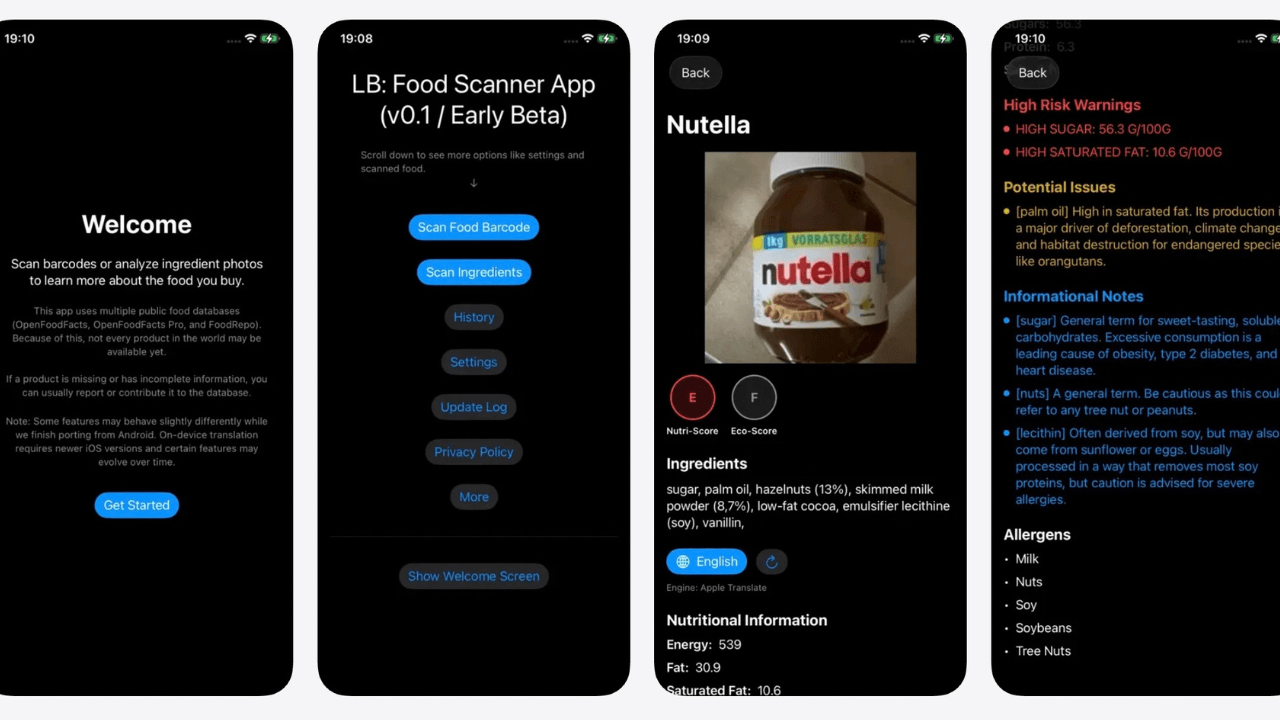
Okay, I’ve read the provided text about Bálint and his app, LB. Here’s a summary of the key takeaways, focusing on the technical aspects and the challenges he faced:
**Key Technical Aspects of LB (The App):**
* **Purpose:** To help users identify ingredients in food products, particularly for those with allergies or dietary restrictions.
* **Barcode Scanning & OCR:** The app uses barcode scanning as an initial entry point, but relies heavily on Optical Character Recognition (OCR) to read ingredient lists from physical labels when barcodes are unavailable or inaccurate.
* **Layered Approach:** LB uses a multi-layered approach to validation:
* Barcode validation
* Data retrieval from databases
* OCR of physical labels
* User review of OCR results
* **Database Limitations:** The app recognizes that barcode information and database records can be incomplete, outdated, or inaccurate.
* **Ingredient Normalization:** The app normalizes recognized ingredients and matches them against aliases to avoid false positives.
* **Barcode Standards:** The app recognizes various barcode formats (1D and 2D) and decodes GS1 data.
* **Payload Classification:** The app classifies the data contained within a QR code or barcode to determine if it contains product information or other data (e.g., website, Wi-Fi credentials).
* **Machine Learning (Limited Role):** Machine learning is used for perception (barcode/text recognition, language identification, translation), but not for making decisions about product safety.
* **Deterministic Rules:** The app uses deterministic rules, bundled ingredient knowledge, and validated identifiers for analysis.
* **User Profiles:** User profiles, allergen settings, notes, favorites, and scan history are stored locally on the device.
* **Privacy-Focused:** The app doesn’t require an account, has no third-party advertising or analytics, and performs barcode/label recognition and ingredient analysis locally.
* **Connectivity:** Connectivity is required for searches of public product databases, live external evidence, recall lookups, and translation.
* **Testing & Validation:** Rigorous testing is performed on the app’s logic, bundled datasets, and ingredient relationships.
* **Transparency:** Warnings identify their source, analysis coverage shows matched/unmatched text, and external records retain their source attribution.
* **Future Potential:** Bálint is open to licensing the underlying technology as an SDK, API, or component for various applications, but with a focus on user agency, privacy, and transparency.
**Challenges Faced:**
* **Inaccurate Barcode Data:** The biggest initial surprise was the discrepancy between barcode information and actual product ingredients.
* **OCR Challenges:** Reading physical labels presents challenges due to tiny print, curved packaging, glare, damaged text, multiple languages, and unusual fonts.
* **Technical Complexity:** Developing a robust and reliable system requires solving complex technical problems related to barcode recognition, OCR, ingredient normalization, and database management.
* **Communication & Outreach:** Communicating the app’s value and getting user feedback is challenging.
* **App Store Requirements:** Meeting app store requirements (e.g., finding testers) can be unexpectedly difficult.
* **Social & Educational Challenges:** Bálint’s autism and learning differences presented challenges within the traditional education system.
* **Balancing Technical Expertise with Other Skills:** Bálint acknowledges that he excels at technical problem-solving but struggles with communication, outreach, and other aspects of running a public product.
* **Stress Management:** Bálint experiences stress related to tasks that others might find simple.
**Key Takeaways:**
* **User-Centric Design:** The app prioritizes user agency, privacy, and transparency.
* **Importance of Validation:** The app emphasizes the importance of validating information from multiple sources and reminding users to compare results with the physical product.
* **Limitations of Technology:** The app acknowledges its limitations and avoids making claims it cannot support.
* **Value of Diverse Thinking:** Bálint’s unique way of thinking, while presenting challenges, is also a source of strength in problem-solving.
* **Potential for Collaboration:** The app’s underlying technology has the potential to be used in various applications while maintaining its core principles.
* **Don’t Underestimate Potential:** Bálint’s story highlights the importance of not judging someone’s potential based on their perceived difficulties.
In essence, LB is a technically sophisticated app built with a strong focus on user safety, privacy, and transparency. Bálint’s journey highlights the challenges of developing and launching a product, especially when dealing with complex technical problems and navigating social and educational systems.
Burimi: Tech.eu